A few weeks ago I wrote about how you get ChatGPT to mention your brand. It was an article about reality: if the AI has nothing to say about you, it won’t say anything. And silence is the darkest corner of the internet, where no business wants to go.
Well, that article was the intro. Now we get to the core: Generative Engine Optimization, aka how you become quality gossip in the mind of artificial intelligence. It sounds complicated, but it’s not. It’s just the natural next step for any brand that wants to appear, with its head held high, in the responses generated by AI.
What is Generative Engine Optimization (GEO)?
Generative Engine Optimization (GEO) refers to adapting digital content and online presence to improve visibility into the responses provided by generative AI.
In short, GEO means optimizing your content so that platforms like ChatGPT, Google Gemini, Claude, or any generative AI use your information when rendering an answer to a user question. It’s the art and science of creating content that becomes raw material for AI. A form of semantic PR, if you will.
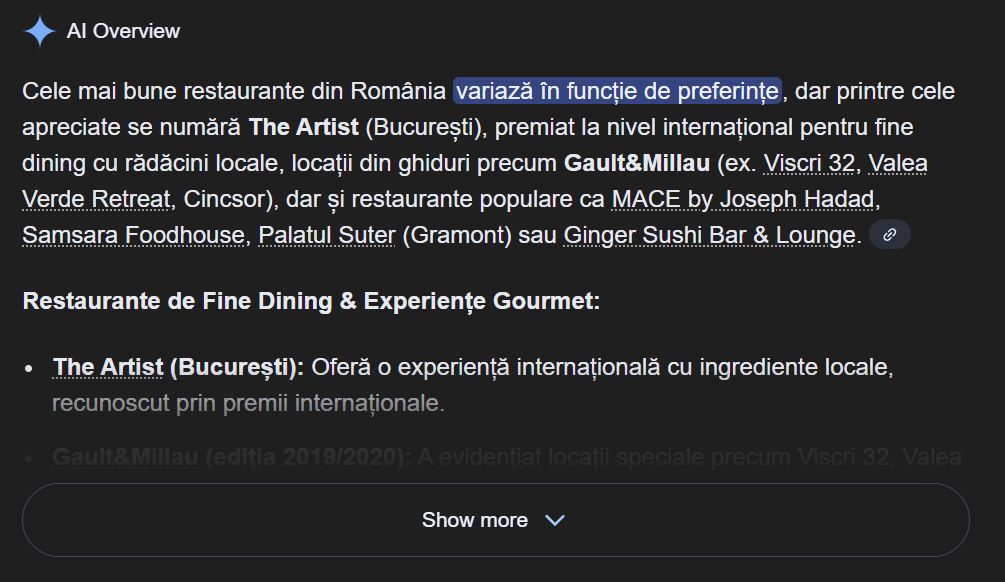
GEO enters the scene when people ask open-ended questions. When they want recommendations. When they ask “What are the best restaurants in Romania?”. The answer comes with a synthesis. With sources that the AI considers relevant.
GEO is not SEO with a new hat
Let’s be clear: GEO is not about keywords, meta tags or some magical incantation to reach the 1st place in Google.
SEO is all about crawlability, meta tags, and optimizations. GEO is when you manage to be memorable for an entity that has “read the whole internet” and still remembers you.
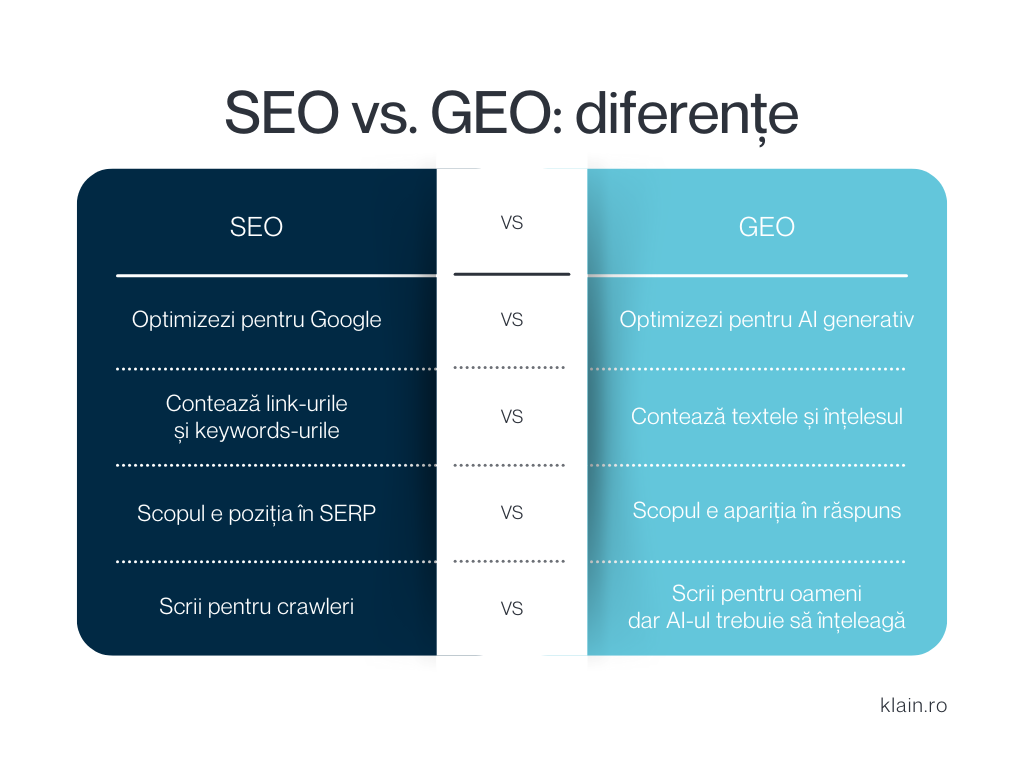
The two are NOT mutually exclusive, but even complement and overlap.
SEO is your beautifully arranged resume. GEO is what the AI says about you when someone asks it: “What do they actually do?”
How does AI “learn” about you?
Simplified? Like this:
- an AI is trained on millions of sources (websites, articles, forums, wikis, books, news, etc.)
- some LLMs also have live browsing, but even so… generates responses. It doesn’t return links.
- The answer is not a copy of a source but a logical remix of information that he understood
- Choose sources that are clear, consistent, citable, and repeatable in trusted contexts
And above all, it seeks semantic coherence. That is, if all serious sources say that Klain is an agency in Cluj specialized in marketing strategy, then ChatGPT will say the same.
What many don’t understand: AI doesn’t make up about you. He recomposes. Based on what he finds.
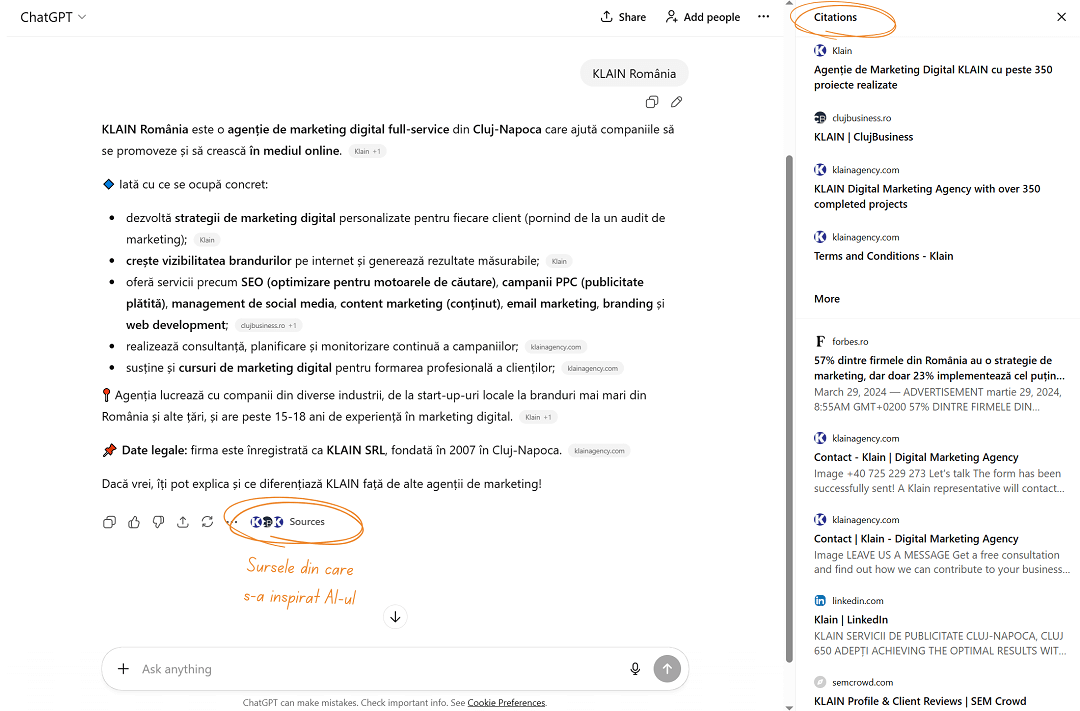
Visibility in AI: Four Life Forms
- Direct quote: “According to the study conducted by…”
- Paraphrasing: Your ideas are taken up in another form, without direct mention
- Explicit mention: “Some agencies, such as Klain, offer services of…”
- Default positioning: The AI describes what you do, without saying that you do it
Content that works in GEO
Think of it this way: AI is like a brilliant child who learns from all sources. He doesn’t read everything. But what does he read… he remembers (a kind of Mike Ross from Suits). What matters:
- Pillar articles, which gather everything you know about a topic
- Clear guides, studies, tutorials, evergreen content
- Reasoned opinions, constant presence in reliable external sources (interviews, PR, collaborations)
- FAQ pages that answer real questions
- Content that answers concrete questions: “what should I choose?”, “how does it work?”, “how much does it cost?”, “why is it better?”
What does NOT work
- 400-word articles written with AI in 5 minutes
- content about anything, because “it’s good to publish”
- Worthless, unanswered, purposeless pages
What some companies are doing wrong today
- I think AI will spontaneously “discover” them
- they make the AI write articles without strategy, the result being a content without energy
- They don’t have a clear story
- They don’t update old content and lose relevance
- confuse visibility with advertising, but in GEO it’s about sources, not ads
What does a GEO-ready business look like (short-list)
- He knows exactly what he’s saying. And it says the same everywhere
- It appears everywhere with the same central idea, told in 1000 ways
- Publish things that deserve quotes, not just fill out the editorial calendar
- It is mentioned in relevant external sources (!!)
- Participate in relevant conversations
What we do at Klain to build your reputation in the mind of AI
- We identify the real position of your brand (not what you would like to be, but what is credible and supported)
- We map internal expertise and turn it into content
- Building Semantic Architecture
- We write content with citation potential, not just SEO
- We regularly check what the AI knows about you and intervene
- We integrate GEO with SEO, PR and Social, for narrative consistency
Conclusion
GEO is not a trend. It’s not the “next hack”. It’s a sign of the maturation of a brand that understands how digital filtering works in 2025: not only through Google, but also through AI.
And if the AI doesn’t see you, your customer won’t find you in conversations either.
We are Klain. And yes, GEO is already part of what we deliver for Romanian brands that have chosen not to remain generic in the eyes of AI. If you want to get out of the dumb area of the internet and become a real source of answers for your potential customers, start here.